
Key takeaways: The right offsite retreat location in Texas is the one that takes work off your plate, not the one with the longest amenity list.
- A company offsite is a working trip with a defined outcome, which makes it a different planning problem than a half-day team-building exercise.
- Format matters more than features. A hotel room block, a cluster of vacation rentals, and a whole-property buyout produce three very different weekends.
- Sleeping capacity, not event capacity, is the real constraint on most corporate retreats in Texas. Check it first.
- “Full-service” should mean lodging, meeting space, meals, bar, and activities under one agreement with one point of contact.
- Write down the outcome you need from the three days, then shortlist only the properties that can host your entire group overnight.
Getting handed the offsite is a specific kind of assignment. Someone above you decided the team needs a few days together, and now your browser is full of venue pages that all say roughly the same four things. Choosing an offsite retreat location in Texas gets easier the moment you stop comparing amenity lists and start comparing formats, because the format is what decides how much work lands on you between now and the first morning.
That work is worth doing carefully. Writing in Harvard Business Review, researchers from Babson, Harvard, and Dartmouth argued that offsites function as a strategic tool rather than a longer meeting, reshaping the informal networks people rely on to get work done. A venue cannot manufacture that on its own. It can absolutely get in the way of it.
We host company groups at three Texas Hill Country properties, and the questions below come up on nearly every planning call. They are worth asking any venue you are considering, ours included.
What Makes an Offsite Retreat Location in Texas Different From Team Building?
The two get used interchangeably, and they are not the same job. Team building is an activity: a ropes course, a cooking class, an afternoon of field games. It has a start time and an end time, and it usually lives inside a larger event.
An offsite is the larger event. It is a working trip with an agenda, an outcome someone will ask about afterward, and a group that has to eat, sleep, and think in the same place for two or three days. Executive team building retreats sit between the two, pairing a leadership working session with the shared experience that makes the session go better.
That distinction changes what you shop for. If you need a team-building activity, you need a vendor. If you need an offsite retreat location in Texas, you need a place that absorbs lodging, meals, meeting space, and downtime for the whole group without you assembling those pieces separately. Most of the frustration planners describe comes from buying the first when they needed the second.
What Does “Full-Service” Actually Mean for Company Retreats in Texas?
Almost every venue in the Hill Country uses the phrase and very few define it, which is why it is worth pinning down before you request a proposal. A useful working definition: full-service means lodging, meeting space, food, beverage, and activities all sit under one agreement, with one person you can call.
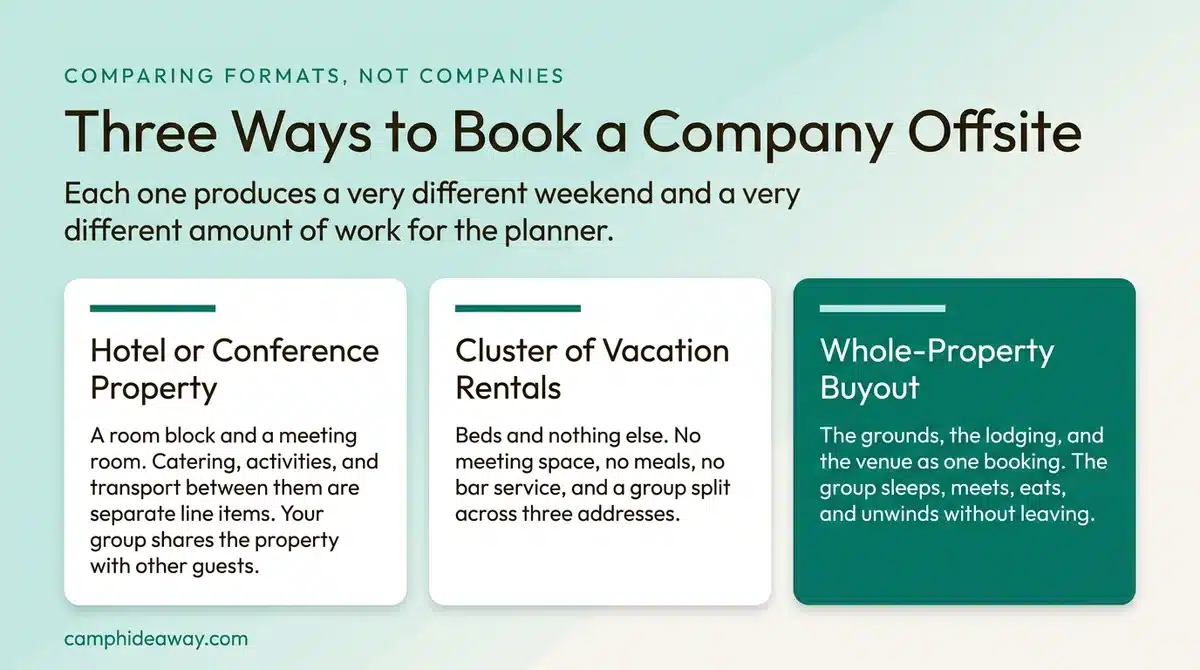
Test that against the three formats company retreats in Texas usually take.
A hotel or conference property gives you a room block and a meeting room. Everything else is a separate line: catering minimums, off-site activities, transportation between them, and a group that scatters into the lobby bar at 6 p.m. alongside other guests.
A cluster of vacation rentals gives you beds and nothing else. No meeting space, no meals, no bar, and a group split across three addresses with a designated driver problem.
A whole-property buyout gives you the grounds, the lodging, and the venue as one booking. The group sleeps, meets, eats, and unwinds without leaving, and nobody is negotiating a shower schedule or coordinating a caravan.
Our own retreats run three days and two nights of exclusive use of one property. That covers lodging for the whole group, a dedicated indoor meeting space with a whiteboard, HD projector, and large-format screen, meals prepared by Shepherd’s Table, full bar service through Southern Star Beverage Co., and a menu of Hideaway Experiences: yoga, archery, guided nature hikes, wine and whiskey tastings, cutting board branding, hat bars, massage, live music, and skeet shooting at our Spicewood property.
How Do You Match Group Size to an Offsite Retreat Location in Texas?
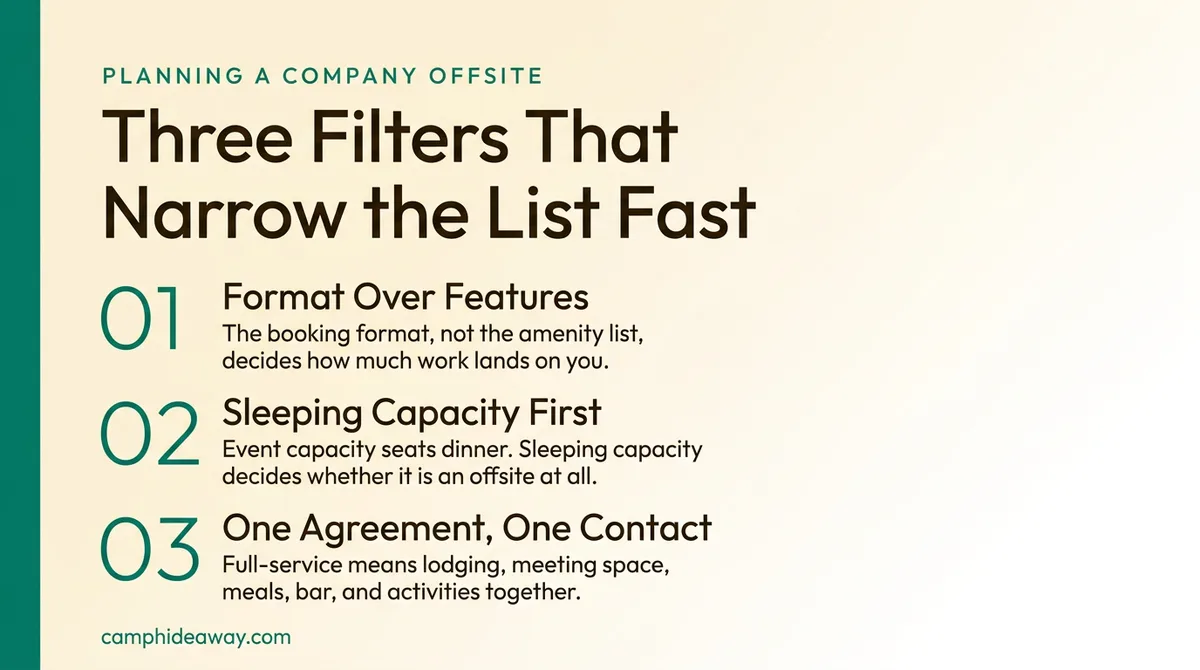
Here is the mistake worth avoiding: planners shortlist by event capacity, then discover late that the property sleeps a third of the group. Event capacity tells you how many people fit in the reception hall for dinner. Sleeping capacity tells you whether your corporate retreat in Texas is actually an offsite or a hotel block with a nice dinner attached.
Check sleeping capacity first, then work outward. Here is how our three properties compare.
| Property | Event Capacity | Lodging Footprint | Drive From Austin | Best Fit |
|---|---|---|---|---|
| Fredericksburg | Up to 200 guests | Ranch House, Sunrise House, and twelve luxury tent suites across two ridges | About 1 hour 30 minutes | Teams who want wine country and outdoor adventure built into the agenda |
| Gruene | Up to 175 guests | Main House, Historic Cabin, The Pharmacy, four Farm Houses, Homestead Farm House, Tiny House | About 45 minutes | Groups who want a walkable historic town and river access nearby |
| Spicewood | Up to 200 guests | Sleeps up to 48 across the Main House, The Ashton, The Annie, The Bunkhouse, and The Stables | About 45 minutes | Larger corporate groups who want the most complete meeting and event infrastructure |
Every property is a single-group booking. You will not share the pool, the fire pits, or the lawn with another company that weekend, which is the part planners tell us matters most once they arrive. It matters even more for executive team building retreats, where leadership needs to talk candidly without a stranger at the next table.
Which Hill Country Setting Fits Your Team?
Once headcount narrows the list, the tiebreaker is what sits just outside the gate. We frame the three as adventure, connection, and transformation, and the difference is less about the lodging than about what your group can walk into on the second afternoon.
Fredericksburg
The property sits high enough for panoramic views, minutes from Main Street and just off Highway 1376. According to Visit Fredericksburg, nearly 100 wineries, vineyards, and tasting rooms operate across Fredericksburg and Gillespie County, and we can arrange a private shuttle tour through them. Enchanted Rock and Luckenbach are both close enough for an afternoon. Teams that want the destination doing some of the work choose this one, and Fredericksburg corporate events are usually built around a half-day out in wine country.
Gruene
Gruene sits between San Antonio and Austin, which makes it the easiest property for a group flying into two different airports. Visit New Braunfels describes the Gruene Historic District as a walkable stretch of German-Texan architecture anchored by Gruene Hall, the oldest continually operating dance hall in Texas. The Guadalupe River is minutes away. The reception hall holds 175 with a built-in bar and staging kitchen, and you get exclusive use from 9 a.m. to 11 p.m. with the flexibility to bring your own vendors, which is why Gruene corporate events tend to run long into the evening.
Spicewood
Sixty-seven private acres between Austin and Marble Falls, with the most complete event infrastructure of the three. The grounds include a heated resort pool, a dry sauna and cold plunge, hike and bike trails, yard games, and an on-site supply hub at the pool courtyard for coffee and grab-and-go breakfast. Krause Springs, Opie’s BBQ, Lake Travis, and Hamilton Pool Preserve are all short drives. It handles our biggest groups and longest agendas, which makes Spicewood retreats the flagship of our corporate retreats in Texas.
7 Questions to Ask Before You Book an Offsite Retreat Location in Texas
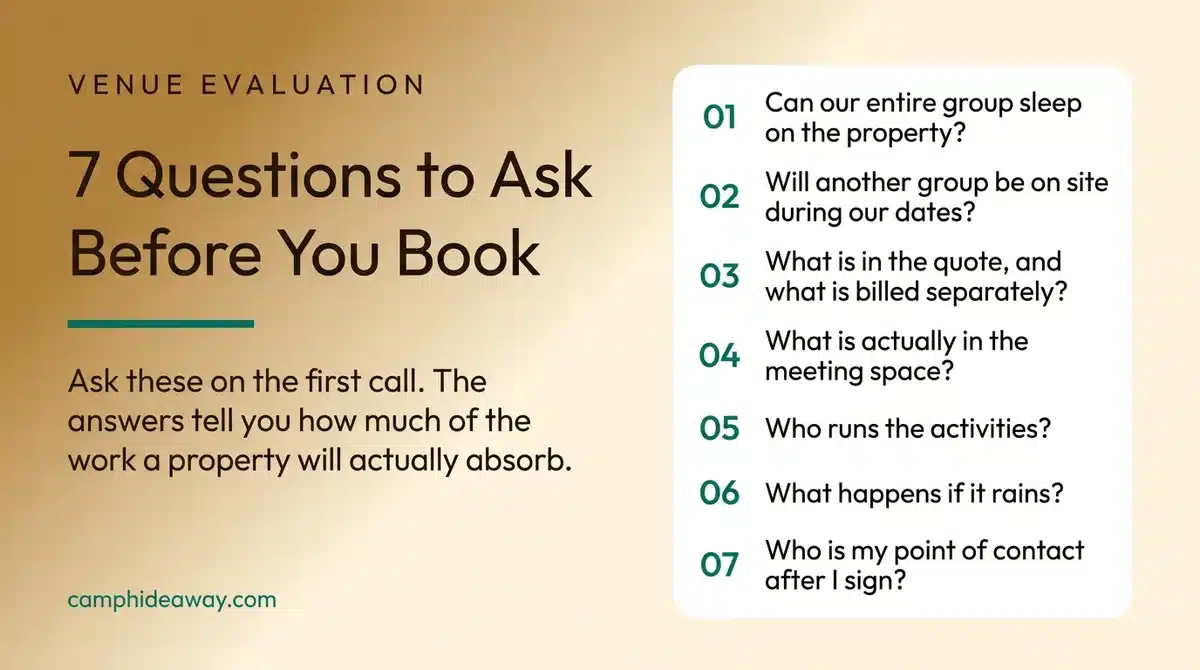
Ask these on the first call. The answers tell you quickly how much of the work a property will actually absorb for you.
- Can our entire group sleep on the property? If the answer involves a nearby hotel, you are planning transportation, not a retreat.
- Will another group be on site during our dates? One event per day and one group per property are different promises. Ask which one you are getting.
- What is in the quote, and what gets billed separately? Lodging, meals, bar, meeting space, and activities should be itemized clearly, whether or not they arrive as one number.
- What is actually in the meeting space? Ask about the screen, the projector, a whiteboard, power access, and connectivity. “We have a meeting room” is not an answer.
- Who runs the activities? A venue hosting its own programming saves you from sourcing a separate vendor for every hour of the agenda. This matters most for executive team building retreats, where the activity is doing real work.
- What happens if it rains? Any venue worth booking has already built a Plan B and will walk you through it without being asked twice.
- Who is my point of contact after I sign? For corporate retreats in Texas, this one predicts your stress level for the next four months. You want a name, not an inbox.
What Does a Three-Day Corporate Retreat in Texas Actually Look Like?
The agenda matters, but the shape of the three days is what people remember. Here is the arc we watch play out again and again.
Day one is arrival. The group comes through the gate, finds their rooms, and starts to decompress before anyone asks them to. Nobody is scheduled for anything except dinner. The first meal together is where the team stops being a list of calendar invitations, and the fire pit afterward is where the real conversations happen, long after the agenda ended.
Day two is the working day. Coffee is out early, breakfast is unhurried, and the meeting space is set before anyone walks in. Teams focus differently here, partly because the room has natural light and partly because nothing else is competing for their attention. The session ends by early afternoon and the rest of the day belongs to the group: a shuttle into town, a competition on the lawn, a hammock, or the pool. The afternoon is where most of the stories come from.
Day three is the slow one. One more chef-prepared breakfast, one more porch conversation, no rush to load the cars. A corporate retreat in Texas gets judged on what happened in the meeting room, but the honest measure shows up here, in how reluctant everyone is to leave.
Frequently Asked Questions
How many people can you host for a company offsite?
Event capacity runs up to 200 guests at Fredericksburg and Spicewood, and up to 175 at Gruene. Spicewood sleeps up to 48 across five buildings. Share your headcount early and we will tell you plainly which properties fit.
Are your retreats always three days?
Three days and two nights is the standard format, and it is the one we recommend because the second night is where most of the value shows up. Shorter formats are available on request. Ask during your consultation.
Do you publish pricing for company retreats in Texas?
We quote per group rather than posting a rate, because the number moves with group size, season, property, and which experiences you add. The retreat is all-inclusive, so a quote covers lodging, meals, bar, meeting space, and activities together. You get a transparent, itemized proposal after a short consultation.
Can we bring our own vendors or facilitator?
Yes. Outside facilitators, speakers, and photographers are common on corporate retreats in Texas, and our venues allow you to bring your own vendors, with a site check for anyone who has not worked with us before. Food and bar service run through our in-house partners so catering and beverage logistics stay off your plate.
Are your properties dog friendly?
All three are. It comes up more often than you would expect on corporate bookings.
Choosing Your Offsite Retreat Location in Texas
Run your shortlist through the overnight-capacity filter and it gets short fast. What survives will differ mostly in one thing: how much of the planning the property takes off you.
That absorption is the whole argument for a whole-property buyout, and it is what we built Camp Hideaway around. One property, one group, one point of contact, no vendor juggling between now and arrival. Your team sleeps, meets, eats, and unwinds on the same grounds, and you spend your energy on the agenda instead of the logistics. Tell us your group size, your dates, and what you want out of the time together, and we will plan your Hill Country retreat and send back a full proposal with a draft itinerary.


