Wedding Venues in Fredericksburg, TX: What Makes Camp Hideaway Different

30 min read

The Shortlist Problem Every Fredericksburg Couple Hits

You have five Fredericksburg venues on your shortlist. Four of them offer a ceremony site and a reception space, then your guests scatter to B&Bs, hotels, and Airbnbs across town. The fifth keeps everyone on the same property from Friday afternoon through Sunday morning. That split sounds like a minor logistical detail. It isn’t. It reshapes the entire weekend.

Start with what the standard model actually produces once you move past the photos. Your guests drive in from Austin, San Antonio, Houston. They check into accommodations spread across Fredericksburg’s Main Street corridor and surrounding neighborhoods. Now you need shuttle logistics: pickup times, routes, a vehicle large enough for your group, a return schedule that accounts for guests who want to leave at 10 PM and guests who want to stay until last call. You are coordinating transportation for people who came to celebrate, not commute.

Then there are the noise curfews. Many Fredericksburg venues sit near residential areas or operate under county noise ordinances that require music to stop by a specific hour. When the music cuts, the evening ends abruptly. Guests who rode a shuttle have no choice but to board it. Guests who drove start checking their phones for directions back to wherever they’re staying. The reception doesn’t wind down naturally; it gets a hard stop. The people who traveled the farthest often leave the earliest because they have the longest drive back to an unfamiliar rental.

What disappears entirely in that model is the morning after. No shared breakfast. No stories swapped over coffee while the couple opens cards. No lazy Sunday where the whole group is still together, still in the glow of the night before. The wedding becomes a single event inside a single evening instead of a weekend that breathes.

The alternative is a lodging-included model. One property holds the rehearsal dinner, the ceremony, the reception, and the overnight stay. Guests walk back to their rooms instead of climbing into a van. The evening continues at a bonfire or around a porch because there is nowhere else anyone needs to be. The wedding weekend extends past 11 PM not because you fought for a noise variance, but because the property was designed for exactly this.

That structural difference is the axis on which everything that follows turns.

What the Fredericksburg Property Actually Looks Like

Start at the entrance and walk it. The Fredericksburg property sits on open Hill Country terrain where the land rolls gently and native cedar and live oak dominate the tree line. Limestone outcroppings surface naturally across the grounds, giving the landscape a texture that feels geological rather than designed. The sky here is wide. There are no adjacent rooftops or commercial buildings competing for your sight line. On a clear evening, the horizon stretches far enough that golden hour light fills the property from a low angle, warming the limestone and turning the grass amber for a solid forty minutes before sunset.

Fredericksburg luxury glamping tent exterior at Camp Hideaway — private fire pit and Adirondack chairs

The lodging structures and the event spaces sit in close proximity but not on top of each other. Guests walk between them on open ground, not through hallways or parking lots. The distance is short enough that nobody needs a shuttle or a map, but generous enough that the ceremony site feels like its own place, separate from where people slept and got ready that morning. Sight lines between the spaces are open. You can stand near the cabins and see the event area across the property, which means your guests orient themselves naturally without signage or a coordinator waving them forward. That spatial relationship matters more than most couples realize during planning. It is the reason the whole weekend feels connected rather than segmented into locations.

What registers most on a walkthrough is the sense of enclosure without confinement. The property is private. There are no shared fences, no neighboring event operations running a parallel timeline on the other side of a tree line. Your group has the full run of the grounds, which changes the way people behave. Guests spread out. They find a fire pit, a porch, a patch of shade under a live oak, and they settle in. The scale of the property supports that kind of organic movement without ever feeling empty or sprawling. It is sized for a wedding gathering, not a festival and not a backyard.

Indoor and outdoor spaces relate to each other the way a farmhouse relates to its land. The structures provide shelter, prep space, and climate control where you need it, but the property’s character lives outdoors. The ceremony backdrop is the Hill Country itself: open sky, native trees, that long golden light. Reception space transitions naturally between covered areas and open ground, so your evening can move with the temperature and the energy of the crowd rather than being locked into a single room.

This is what separates a retreat property from a rental hall. A hall gives you a room. This gives you a place. The difference registers immediately on arrival and shapes every photograph, every conversation, and every memory your guests carry home. If you want to see the grounds before scheduling a visit, the photo gallery shows the property across seasons and times of day. But photographs only do so much. The thing that surprises most couples on their first walkthrough is the quiet. Standing on the ceremony site with nothing but wind in the cedar, you understand why the weekend model works here. The land itself sets the pace.

How the Ceremony Space Performs on Wedding Day

Friday ends with the rehearsal dinner, everyone settling into their cabins, and the anticipation that comes from being in the same place together the night before. By the time Saturday afternoon arrives and guests begin moving toward their seats, the ceremony site has been part of their world for nearly a day, and that familiarity makes the moment feel earned rather than staged.

The ceremony site at Camp Hideaway is not an afterthought. The team chose it for a specific combination of elevation, tree cover, and sight lines that make it function as a natural amphitheater. Your guests are seated with the Hill Country landscape opening behind the altar point, so every photograph captures depth and texture without competing with harsh direct light. The orientation takes advantage of afternoon sun filtering through the canopy rather than blasting into anyone’s eyes, which matters more than most couples realize until they’ve attended an outdoor ceremony facing due west at 5 PM.

The processional route is intentional, not improvised. The couple’s entrance follows a defined path that keeps them hidden from guests until the moment they appear, creating a genuine reveal. Guests are seated in a configuration that places everyone close to the ceremony, not spread across a sprawling field where the back rows strain to hear. The natural grade of the terrain gives slight elevation changes that improve visibility without a built platform, though one can be added if the couple prefers a raised altar.

Acoustics are a real consideration for any outdoor ceremony. The tree line around the ceremony space acts as a natural sound buffer, reducing wind noise and keeping voices contained within the seating area. Most couples opt for a small speaker setup for their officiant and any readings, and the venue’s layout makes that straightforward. There are no competing noise sources: no highway, no neighboring event space, no restaurant patio. The only ambient sound is the property itself.

Weather contingencies are built into the planning process, not scrambled together the morning of. The property offers covered structure options that can serve as a full indoor backup for the ceremony if conditions turn. Your coordinator works through the contingency plan well in advance so the decision tree on a rainy morning is clear and calm, not chaotic. The backup space is a real venue setting, not a tent thrown over a parking area.

Shade is worth addressing directly because Texas heat is not hypothetical. The ceremony site benefits from mature tree coverage that keeps the area noticeably cooler than open ground. Couples planning warm season ceremonies can also adjust timing to take advantage of the golden hour window when temperatures drop and the light turns soft across the hills. You can explore more about how the full wedding weekend comes together at the Fredericksburg weddings page.

Every element of the ceremony space solves a real problem: where the light falls, where sound carries, where guests sit comfortably, and where the couple stands so the backdrop earns its place in every frame. The space performs because it was designed to. And when the ceremony ends and the light shifts toward dusk, the evening is already in motion because the reception is right there, waiting, on the same ground where your guests have spent the last hour watching you get married.

Reception Without a Checkout Clock

The ceremony ends, the sun drops behind the hills, and dinner begins. At most venues, this is also the moment a quiet countdown starts. Someone on the planning team is tracking shuttle schedules. The bar has a hard stop dictated by the rental contract. Guests glance at their phones, calculating the drive back to their hotel. The energy of the evening peaks early and then deflates as logistics take over. That is the standard reception experience, and most couples accept it because they assume there is no alternative.

At Camp Hideaway, the alternative is simple: your guests are already home. Their bags are in their cabins. Their beds are a short walk from the dance floor. Nobody is watching the clock, and nobody is managing departure logistics, because there is nowhere to depart to. That single structural fact changes the entire atmosphere of the reception.

You feel it first at the tables. Conversations stretch longer. Guests order another drink without doing mental math about a drive. The uncle who flew in from out of state actually sits down with the college roommates he has never met, because the evening does not feel like it is winding down. The couple spends real time at each table instead of rushing through a circuit before the venue kicks everyone out. Dinner becomes an event in itself rather than a checkpoint between the ceremony and the send-off.

The dance floor benefits too. When guests know the night extends as long as they want it to, they commit. They take off their shoes. They request songs from the DJ that only make sense at midnight. The energy builds in waves instead of cresting once and collapsing. There is no announcement that the bar is closing in fifteen minutes, no coordinator herding people toward a parking lot. The music plays, and people stay, because staying is effortless.

Then comes the part that event-only venues cannot offer: the second act. After the formal reception wraps, the property itself becomes the gathering place. Guests migrate to fire pits, settle into outdoor spaces, and keep the night going on their own terms. The couple, finally free from their hosting duties, joins a smaller circle and actually enjoys the company of the people who traveled to celebrate with them. These are the hours guests talk about for years. Not the first dance, not the toasts, but the unhurried conversations that happen when the schedule disappears entirely.

The catering and bar service relationship works differently here as well. Because Camp Hideaway controls the full environment, there are no hard vendor cutoffs driven by offsite logistics or third-party rental agreements. The food and beverage timeline serves the event rather than the other way around. Late night snacks can appear when the group is ready for them, not when a contract says the kitchen must close. Every detail about how the evening unfolds stays in the hands of the people who actually live on the property and understand how it operates after dark.

This is the reception experience that the lodging-included model at Fredericksburg makes possible. Not a longer party for the sake of a longer party, but a fundamentally different emotional arc. The evening breathes. Guests relax into it. And the couple gets the one thing no timeline can manufacture: enough time with the people they love.

The Morning After Is Part of the Wedding

The reception ends, but the weekend is not over. This is where a venue weekend and a traditional venue booking diverge most sharply.

Luxury tent suite interior at Camp Hideaway Fredericksburg — on-site wedding guest accommodations

At a conventional venue, the last song plays and the dispersal begins. Guests call rideshares. The couple retreats to a hotel. By morning, everyone is scattered across different accommodations, checking out at different times, already halfway home. The wedding is over the moment the lights come up.

At Camp Hideaway, everyone wakes up in the same place. There is no scramble, no coordinating across hotels, no “we should try to grab breakfast before you leave” text chains. The wedding party drifts toward coffee at their own pace. Families linger on porches. Friends who reconnected on the dance floor pick up the conversation right where they left off. It is unhurried and unscheduled, and couples consistently describe it as one of the most emotionally resonant stretches of the entire weekend.

Logistically, this works because there is no early checkout pressure. Guests have the morning. They are not loading luggage at 8 a.m. or racing to return a rental. The property is still theirs, and that sense of shared ownership over the space carries through from the night before. A brunch gathering happens naturally, whether it is a catered spread or something simpler. The point is that it happens at all, with everyone still together, still present.

This is the real value of an extended weekend booking. Couples who reserve the full window at Camp Hideaway Fredericksburg are not just buying extra hours. They are buying a different shape for the weekend. Instead of a single peak moment followed by a sharp drop, the experience has a natural arc: arrival and settling in, the ceremony and celebration, then a slow, warm conclusion the next morning. The wedding ends the way the best weekends end. Not with a sudden stop, but with long goodbyes, full plates, and the kind of quiet gratitude that only comes when nobody has to rush.

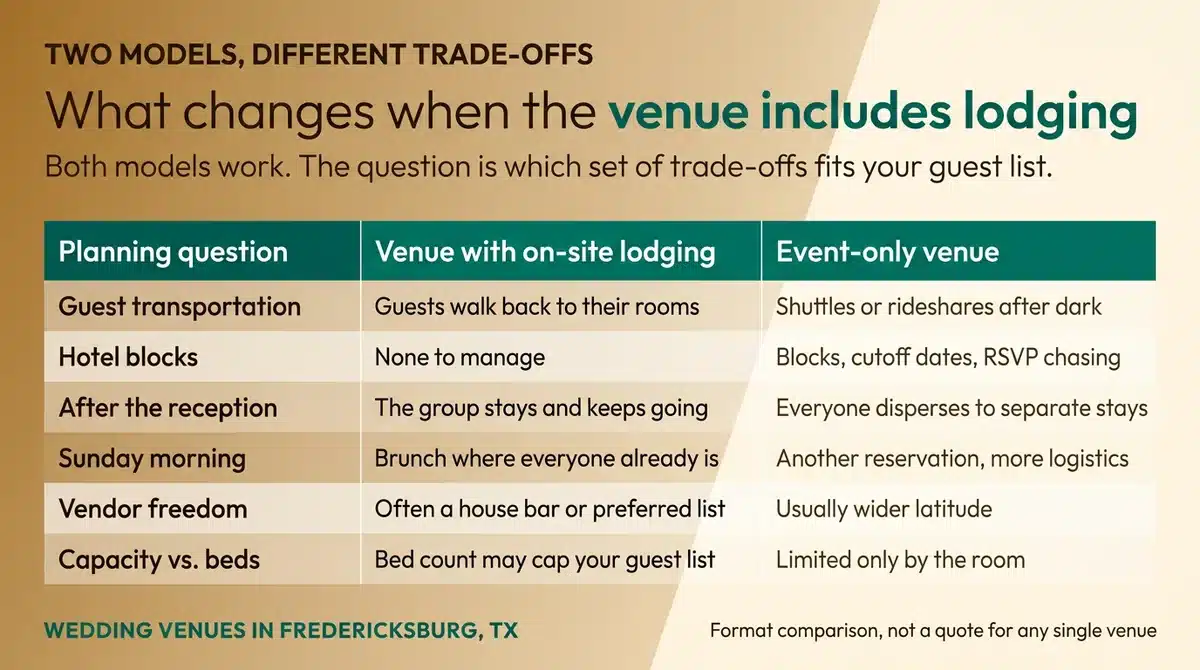
Lodging-Included vs. Event-Only: The Honest Trade-Off Table

Both models work. The question is which set of trade-offs fits your priorities, your guest list, and the kind of weekend you actually want to host.

Planning Dimension Lodging-Included Venue Event-Only Venue
Guest Transportation Guests walk to their rooms. No shuttle contracts, no coordinating pickup windows, no liability questions around late night rides on rural Hill Country roads. Requires dedicated shuttle service or rideshare coordination. You own the logistics and the timing pressure that comes with them.
Noise and Curfew Exposure Private acreage with no residential neighbors means music and celebration run on your schedule, not a noise ordinance. Often subject to municipal curfews or neighbor agreements. Sound cutoffs at 10 or 11 PM are common and non-negotiable.
Post-Midnight Flexibility The party moves naturally from the dance floor to a fire pit or common area. No one needs to leave. The venue closes. Everyone disperses to separate hotels. The night ends with a parking lot, not a bonfire.
Morning-After Gathering Brunch happens organically. Guests are already on site, still in the weekend together. Requires booking a separate restaurant or brunch venue, plus another round of transportation coordination.
Atmosphere Continuity One setting from Friday arrival through Sunday departure. The sense of place compounds over the full weekend. Strong for the ceremony and reception window. Atmosphere resets every time guests leave and return.
Vendor Coordination Single point of contact manages lodging, event spaces, and on-site logistics together. You coordinate across hotel blocks, the venue, transportation vendors, and any secondary locations independently. More control, more moving parts.
Vendor Flexibility Some lodging-inclusive venues have preferred vendor lists. Confirm open-vendor policies before signing. Typically full freedom to bring any caterer, florist, or bar service. This is a genuine advantage for couples with specific creative visions.
Guest Hotel Booking No hotel block management. No tracking who has and hasn’t reserved. Guests just show up. You manage room blocks, cutoff dates, and the inevitable follow-up emails chasing RSVPs and reservations separately.

Neither column is universally better. If your priority is maximum vendor freedom and you have a dedicated planner who thrives on multi-vendor coordination, an event-only venue can deliver exactly what you want. If your priority is keeping your guests together for the full weekend with fewer logistics on your plate, a lodging-included property removes the friction that fragments the experience. Know which trade-offs matter most to you, then schedule a tour to see how the on-site setup matches what you need.

How the Coordination Model Actually Works

Your primary contact is a dedicated venue coordinator, and that relationship begins at booking. This is the person who walks you through site logistics, answers vendor questions, and builds the weekend timeline alongside you. They are not a day-of afterthought. By the time your rehearsal starts, your coordinator already knows your caterer’s contact, your photographer’s shot list priorities, and the specific flow you want between ceremony and reception. That continuity eliminates the “who’s in charge?” confusion that derails timelines.

Camp Hideaway Fredericksburg main house great room — gathering space for wedding groups

On the day itself, the venue team owns the operational timeline. That means they manage vendor arrivals, confirm setup positions, and keep the schedule moving so your wedding planner, if you have one, can focus on you. If you do not have an outside planner, the venue coordinator fills that gap for property logistics: cueing the caterer for service, directing the DJ or band to their power access, and making sure the bar is stocked before cocktail hour opens. When something unexpected happens, and something always does, the coordinator handles it on property without pulling you or your family into the problem.

Vendor access follows a clear structure. Outside vendors receive arrival windows and staging instructions in advance. Load-in happens through designated service areas so that setup activity stays separated from guest spaces. Caterers, florists, and rental companies know exactly where to park, where to unload, and where their staging zones are. Load-out follows the same discipline: vendors break down and exit through service routes while guests continue enjoying the evening. This separation keeps the experience intact for your guests while giving vendors the working space they need to execute well.

The venue team does not replace your vendors. Your caterer still owns the food, your photographer still owns the shots, and your florist still owns the arrangements. What the coordination model does is give every vendor a single point of contact on property who knows the layout, the timeline, and the contingency plan. That structure turns a collection of independent vendors into a coordinated weekend. You can see more about how this works at the Fredericksburg weddings property, where the coordination model is built around multi-day celebrations from the ground up.

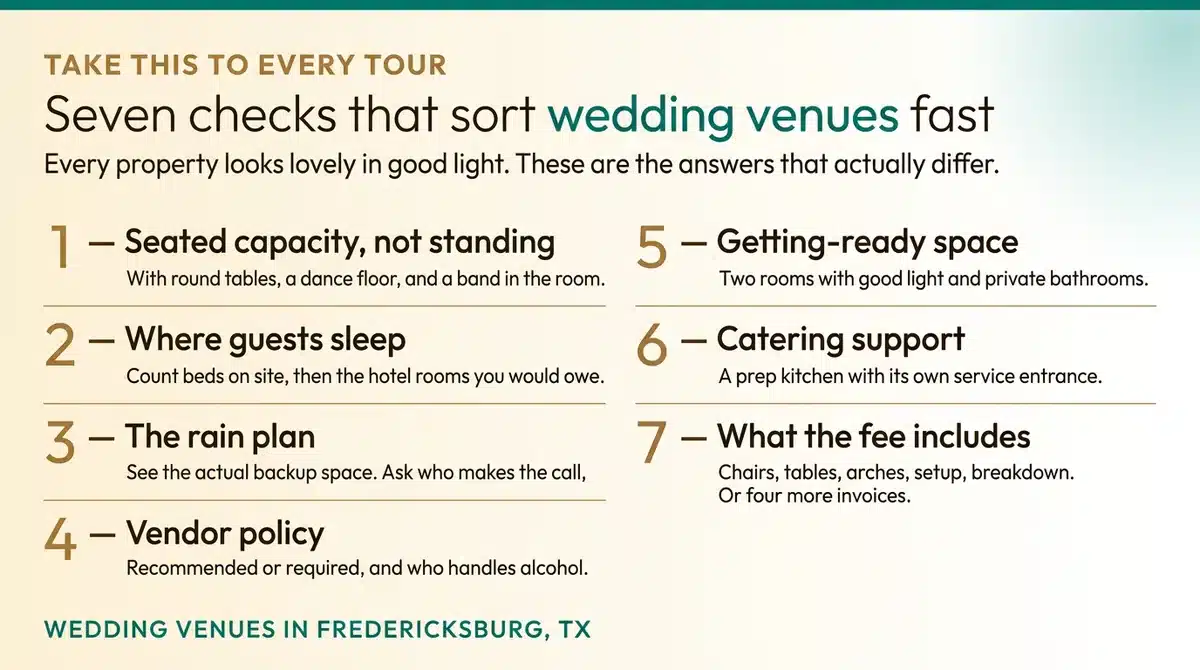
Questions Worth Asking Before You Book Any Hill Country Venue

Bring these questions to every tour you take. The answers will tell you more than any photo gallery ever could.

1. What is the noise curfew, and what happens if the event runs long? Some venues enforce a hard stop at 10 p.m. Others give you flexibility. Ask what the actual consequence is if your band plays one more song or your hora goes late. A vague answer here means a stressful conversation on your wedding night.

2. Do you have a required or preferred vendor list? A preferred list can be genuinely helpful. A required list limits your options. Know which one you are dealing with, and whether there are fees for going outside it.

3. What happens to guests after the reception ends? This is the question most couples forget. If guests have to drive thirty minutes back to a hotel block, the party ends when the reception ends. If they are already staying on the property, the night continues naturally.

4. Who is my primary contact on the wedding day, and how do I reach them? You want a name, a phone number, and a clear scope of responsibility. “Our team will be there” is not the same as a single point of contact who owns your timeline.

5. Will any other events be happening on the property the same weekend? Exclusive use matters. If another wedding or corporate group shares the grounds, your guests share the parking, the noise, and the atmosphere. Ask explicitly whether the venue books overlapping events.

6. What is included in the venue fee, and what requires a separate rental? Tables, chairs, linens, lighting, sound equipment, setup labor. Get the full list in writing so your budget reflects reality.

7. What is the backup plan for weather? Outdoor ceremonies are beautiful until they are not. Ask whether there is a covered structure, an indoor alternative, or a tent provision, and who makes the call to switch.

8. Can we do a walkthrough with our vendors before the wedding? A venue that welcomes vendor site visits values coordination. One that resists it may be harder to work with when logistics get complex.

Print this list. Take it to every tour. Then bring it to the Fredericksburg property, because the answers here are built into the way the place operates, not recited from a sales script.

No article can do what a site visit does. You need to stand in the ceremony space, walk the path from the cabins to the reception area, and feel whether the scale of the property matches the wedding you are planning. Schedule your tour at the Fredericksburg property and find out.

Can we bring in our own caterer, or do we work with a venue-preferred list?

Camp Hideaway works with a preferred vendor list rather than an exclusive required list, which means you have access to vetted caterers the team already knows work well in the space, with established knowledge of the kitchen setup, service flow, and timing expectations. Couples who have a specific caterer in mind outside that list should ask about the open vendor policy during their tour. The key distinction to nail down with any Hill Country venue is whether outside vendors are permitted at all, whether there is a fee for bringing them in, and whether they will have completed a site visit before your wedding day. A caterer walking a venue for the first time on your wedding morning is a risk regardless of how talented they are.

Is the property exclusively ours for the full weekend, or are other events booked simultaneously?

Full weekend bookings at Camp Hideaway are exclusive. When you reserve the property for your wedding weekend, no other event runs on the grounds simultaneously. This matters for reasons that go beyond noise: it affects parking, guest flow, and the atmosphere that makes the lodging-included model work. Shared venue weekends create overlapping vendor traffic, split coordinator attention, and the awkward reality of strangers wandering through what is supposed to feel like your private retreat. Exclusive use is a foundational part of the Camp Hideaway model, so this is one question where the answer is straightforward.

What does the rehearsal dinner setup look like, is it held on property the night before?

Yes, the property supports a full rehearsal dinner on Friday evening as part of the weekend booking. Most couples use this as their guests’ first real gathering on the grounds: a relaxed dinner after the rehearsal itself, with everyone already settled into their cabins. Having the rehearsal dinner on property sets the tone for the whole weekend. Guests orient themselves to the space, families from different sides of the guest list meet each other without the pressure of a wedding timeline, and the couple goes to sleep with everyone already there. The specific setup for the rehearsal dinner depends on your caterer and the space configuration you choose, which your coordinator will walk through during planning.

How far in advance do couples typically book, and how does the hold and deposit process work?

Most couples book Camp Hideaway twelve to eighteen months out, particularly for peak Hill Country season dates in spring and fall. Popular weekends can fill earlier than that. The hold and deposit process typically involves a refundable short-term hold to take the date off availability while you review the contract, followed by a deposit to confirm the booking. The specific deposit amount and payment schedule are outlined in the venue contract. If you have a date in mind, the most practical step is to reach out directly to check availability before investing significant time in planning around a date that may already be spoken for.

Are there noise ordinances or sound cutoffs we need to plan around?

The Camp Hideaway property sits on private acreage without residential neighbors immediately adjacent, which means the noise restrictions that govern many Fredericksburg venues do not apply in the same way here. This is one of the core structural advantages of the property. Rather than planning your reception timeline around a hard sound cutoff at 10 or 11 PM, you work with the venue to determine when formal music and amplified service end based on what fits your event, not what a county ordinance requires. Your coordinator will set clear expectations on sound during the planning process so there are no surprises on the day.

What happens if weather forces the ceremony indoors, what does the backup space look like?

The weather contingency plan is established during planning, not improvised the morning of. The property has covered structures that function as a genuine ceremony backup: a real interior space that holds the ceremony configuration and still feels intentional, not a tent erected over a parking area. Your coordinator will walk through the backup layout during your planning meetings so you know exactly what a shift indoors looks like, who makes the call, and at what point in the morning that decision gets made. Couples planning warm season weddings have the most exposure to heat rather than rain, which the ceremony site’s mature tree coverage addresses to a meaningful degree.

Can out-of-town guests who are not staying on property still attend the reception?

Yes. The lodging-included model does not restrict attendance to overnight guests. Couples typically have a mix: close family and the wedding party staying in the on-site cabins, and additional reception guests who come for the ceremony and dinner and drive home or to their own accommodations afterward. The property handles this naturally; parking and guest flow accommodate both groups. Where overnight guests experience the full weekend arc, reception-only guests still benefit from the atmosphere and setting during the event itself. If your confirmed headcount splits between on-site and off-site guests, your coordinator can help you think through how those two groups move through the day.

How does the venue handle vendor arrival timing and setup on wedding morning?

Vendors receive specific arrival windows and staging instructions in advance of the wedding day. Load-in is coordinated through designated service areas that keep setup activity separate from guest spaces, so your guests are not watching a florist van back up to the ceremony site while they have morning coffee. Caterers, rental companies, and other vendors know exactly where to park, where their staging zones are, and who to check in with on arrival. Your venue coordinator is the single point of contact for all vendor questions on the day. This structure is how a property with multiple vendors working simultaneously stays organized rather than chaotic: everyone has clear instructions before they arrive, not when they get there.

Is there a designated getting-ready space for the wedding party on property?

Yes. The property includes dedicated getting-ready space for the wedding party, which is an important logistical detail that often gets overlooked in early venue comparisons. Having a proper preparation space on site rather than a hotel room across town means your photographer has a controlled environment for getting-ready shots, your hair and makeup vendors have adequate lighting and space to work, and the couple and wedding party arrive at the ceremony relaxed rather than road-stressed. The specific configuration of the getting-ready space is something your coordinator walks through during the planning process, along with timing for when the space is available and how it flows into the ceremony timeline.

What is the checkout process like, do guests need to be off property at a specific time the morning after?

There is a checkout window built into the weekend booking, but it is structured to support a natural Sunday morning rather than a rushed hotel scramble. Guests have time for coffee, brunch, and unhurried conversations before the property needs to begin its transition. The specific checkout time is part of your booking agreement, and your coordinator will communicate it clearly so you can set expectations with your guests. The design intent of the full weekend model is that Sunday morning feels like a genuine conclusion to the wedding, not a logistical afterthought. That unhurried quality is something couples consistently name as one of the most memorable parts of the entire weekend.

Share the Post: